By: Magic City Radar
It is a name that holds, within its four syllables, both a testimony and an indictment. It testifies to what Black people have always known how to do — take the narrow and stony ground this country allotted them and make it flower. And it indicts the country that made such flowering necessary, and then punished it, and then forgot it, and now comes back, checkbook in hand, to admire the ruins of what it once despised.
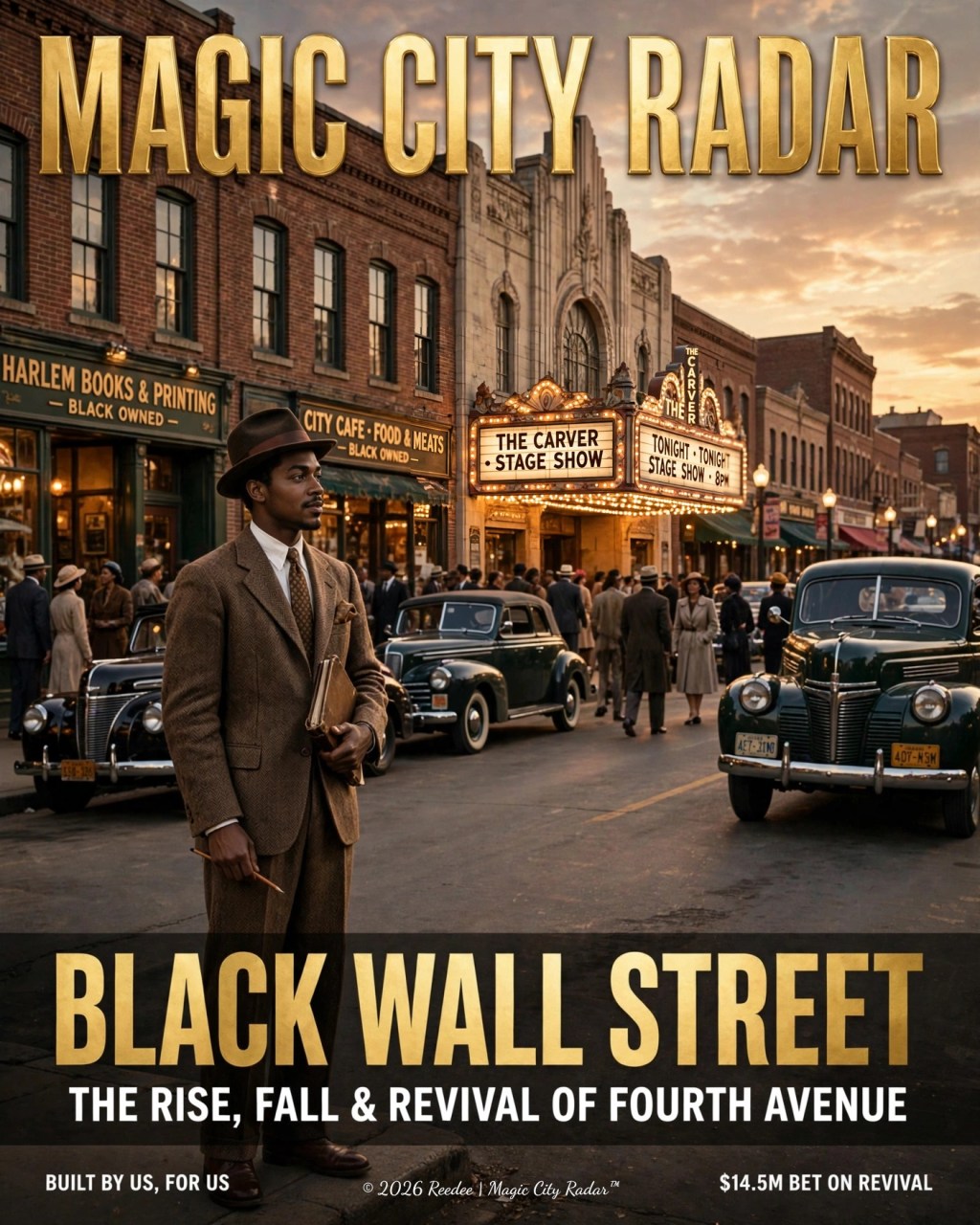
Birmingham had one. Three blocks of Fourth Avenue North, where for the first half of the twentieth century Black Birmingham built an economy out of the nothing America offered it — banks, insurance companies, theaters, hotels, nightclubs, all Black-owned, all thriving, all conjured into being because Jim Crow had declared that Black money was not welcome anywhere else.
And there has never been a more opportune time for its return than now. That is the truth.
Here is the other truth, and it must be spoken plainly: the street, as it stands today, does not invite the people it was built for. You cannot scold a community into spending its money on an avenue that does not feel welcoming, or vibrant, or worthy of the journey. Love is not commanded; it is earned. Any honest reckoning with Fourth Avenue must begin there — with what the street is, and not only with what it was.
What was built
Before 1900, the city’s own historic marker concedes, Black businesses stood shoulder to shoulder with white ones across downtown Birmingham. Then Jim Crow drew its color line, and the Black business community was herded into a narrow corridor — Third, Fourth, and Fifth Avenue North, between 15th and 18th Streets.
What was meant as a cage, Black Birmingham made into an engine. From 1908 to 1941, the National Park Service records, Fourth Avenue was “the center of black social and commercial activity and professional achievement.” And the buildings were Black in every particular: conceived by Black architects, raised by Black builders, financed by Black capital. The six-story Alabama Penny Savings Bank. The seven-story Colored Masonic Temple. The Famous Theatre. The Carver — which stands today as the Alabama Jazz Hall of Fame.
The avenue did not sleep. Barbershops and beauty parlors, restaurants and theaters, hotels and nightclubs; on Friday and Saturday nights the sidewalks filled with crowds, and the people dressed as though they were going somewhere that mattered — because they were. Bob’s Savoy entertained the royalty of Black athletics and Black entertainment. It was, as the marker itself admits, “the place to be.”
And it was more than commerce. It was the movement’s treasury. A.G. Gaston’s Booker T. Washington Insurance Company anchored Black financial power on the avenue, and in the Gaston Motel, in 1963, King and Abernathy and Shuttlesworth drew the battle plans for the campaign that would break segregation’s back. The money earned on Fourth Avenue bankrolled the freedom marched for across the street.
What emptied the street
The marker tells this part, too, with an honesty one must respect. When the movement opened doors that had been nailed shut — “many new doors were opened literally and figuratively,” the marker says — many Black businesses, the hotels and the cafes especially, began to wither. Admitted at last to white establishments, many Black customers did not come back to the Black-owned businesses that had sheltered them when no one else would.
The avenue was not killed by racism alone. It was killed, in part, by the departure of its own people’s dollars.
And there is a second movement to this tragedy, seldom spoken: as the dollars departed, the street declined, and as the street declined, the dollars found ever better reasons to stay away. Disinvestment is a wheel that grinds everyone it touches. The avenue ceased to be a place one desired to go, which supplied the reason not to go, which deepened the ruin. Nostalgia will not break that wheel. Only a street worth desiring will.
The price of the ticket
And now — now the money is coming. One must look at it clearly.
The 4th Avenue Forward program. A $14.5 million federal grant to make the avenue two-way again, to stitch it back into the city’s body. The Arthur Shores Building, bearing the name of the Black attorney who defended King, now housing CREED 63 and a new generation of entrepreneurs. The Ballard House restored. The jazz festival filling the street with music each year. The National Monument standing sentinel over it all.
The complaint that the street is not attractive enough is being answered, in real time, with millions of dollars. Very well. But every dollar that makes Fourth Avenue beautiful makes it valuable — and value, in America, has a color. What Baldwin once named, with his terrible precision, “Negro removal” has always arrived dressed as renewal. The pattern is old and unvarying: the money comes, the property rises, and the people for whom the revival was proclaimed find themselves priced out of their own history — tourists on a Black Wall Street they no longer own.
So the headline asks its question, and the question demands an answer: rejuvenation or gentrification?
Rejuvenation means the community possesses the revival — the deeds, the businesses, the wealth it creates. Gentrification means the community is granted a lovelier street to stroll while strangers collect the rent. The difference was never the amount of money. It is who holds the deeds.
This is why “show up” cannot mean patronage alone. It must mean ownership. Buy the building. Open the business. Enter now, while the prices still confess the disinvestment, before outside money writes Fourth Avenue’s future without us. The wealth is beneath our nose. It will not remain there.
Why the hour is late — and larger than money
Yet the hour’s urgency is not only the funding. It is the hour itself.
The economy is strangling Black families. The country’s divisions are widening into chasms. There has not been a time in recent memory when we have needed one another more — and that is not sentiment, it is arithmetic. When the wider economy turns hostile, the communities that possess their own establishments endure. When the culture fractures, the communities that possess their own gathering places hold.
We must build, and we must have, establishments that belong to Black people in the deepest sense — not merely businesses that happen to be Black-owned, but institutions in which Black Birmingham can flourish, through which our dollars can circulate among us, by which we can take care of our own. That is what Fourth Avenue was: not a row of shops but an ecosystem. A bank that lent when white banks would not. An insurance company that covered whom others refused. Theaters in which we were the audience, never the balcony. That is the model — not a museum of 1941, but a blueprint for now.
Both sides, or neither
Then let the terms be stated plainly, for they bind both parties.
Those who hold the money — the developers, the city, the powers behind this revival — must make Fourth Avenue worthy of the people it claims to serve: safe, beautiful, alive with enterprises worth patronizing. Grants and façades are a beginning, not a fulfillment. The standard must be a district Black Birmingham is proud to claim, not one it is conscripted to rescue out of duty.
And the community must come — with dollars, with enterprises, with its presence. Dine in the cafes on the avenue; do not merely photograph them. Sustain the entrepreneurs of CREED 63 with contracts, not applause. Bring the children to the jazz festival and spend on the street while the music plays. Open the business there — there, not merely anywhere.
One side without the other is a failure. A beautiful avenue no one patronizes is a museum. A willing people with nowhere worthy to gather is goodwill without an address.
The choice
The first Black Wall Street was built by a people who had no choice but one another — and they transmuted captivity into capital. The second must be built by a people who choose one another, in an hour when that choosing has never carried more weight.
The buildings stand. The money waits. The street is being remade. The times insist.
It is, now as ever, a question of will — on both sides of the street.
Sources: National Park Service, National Register of Historic Places nomination form for the Fourth Avenue Historic District; National Trust for Historic Preservation; City of Birmingham historic marker text (via Bhamwiki); Birmingham Historical Society / NPS registration form for the Birmingham Civil Rights District; myv949 reporting on the district’s revitalization.

