
By: Magic City Radar
They waited 159 years for a court to read a treaty the way it was written.
In July 2025, the Supreme Court of the Muscogee (Creek) Nation struck the words “by blood” out of the Nation’s citizenship law and ordered the enrollment of the Creek Freedmen — Black men and women whose ancestors were enslaved by the tribe, freed by treaty, and then legislated out of the Nation by constitution.
Rhonda Grayson and Jeffrey Kennedy brought the case. What they won was not a gift. It was a debt, paid late.
The promise: 1866
The war was over. In 1866 the Muscogee Nation put its name to a treaty with the United States, and the treaty said what treaties do not usually say plainly: the freedmen who remained in Creek territory would be citizens. Full citizens. One of the signers was Cow-Tom, himself of African descent, who saw to it that the promise was written down where no one could pretend it wasn’t there.
It was not charity. These were not strangers being taken in. The National Archives state it without ornament: “The Creek Indians intermarried with slaves so their bloodlines were mixed.” Enslaved people were taken into the clans. They spoke the language. They kept the ceremonies. A white observer in the 1700s recorded that those who married into the tribe “become Indians or free citizens,” holding equal standing.
When the soldiers came with the removal orders, Black Creeks walked the Trail of Tears beside the tribal towns, mile for mile, grave for grave. When the Nation rebuilt itself in Indian Territory, Freedmen sat in its government — in the House of Kings, in the House of Warriors. They did not beg for a place. They had one. They had earned it the way every people earn a place: by living, marrying, suffering, and governing together.
The erasure: 1900 to 1979
Then the paper came.
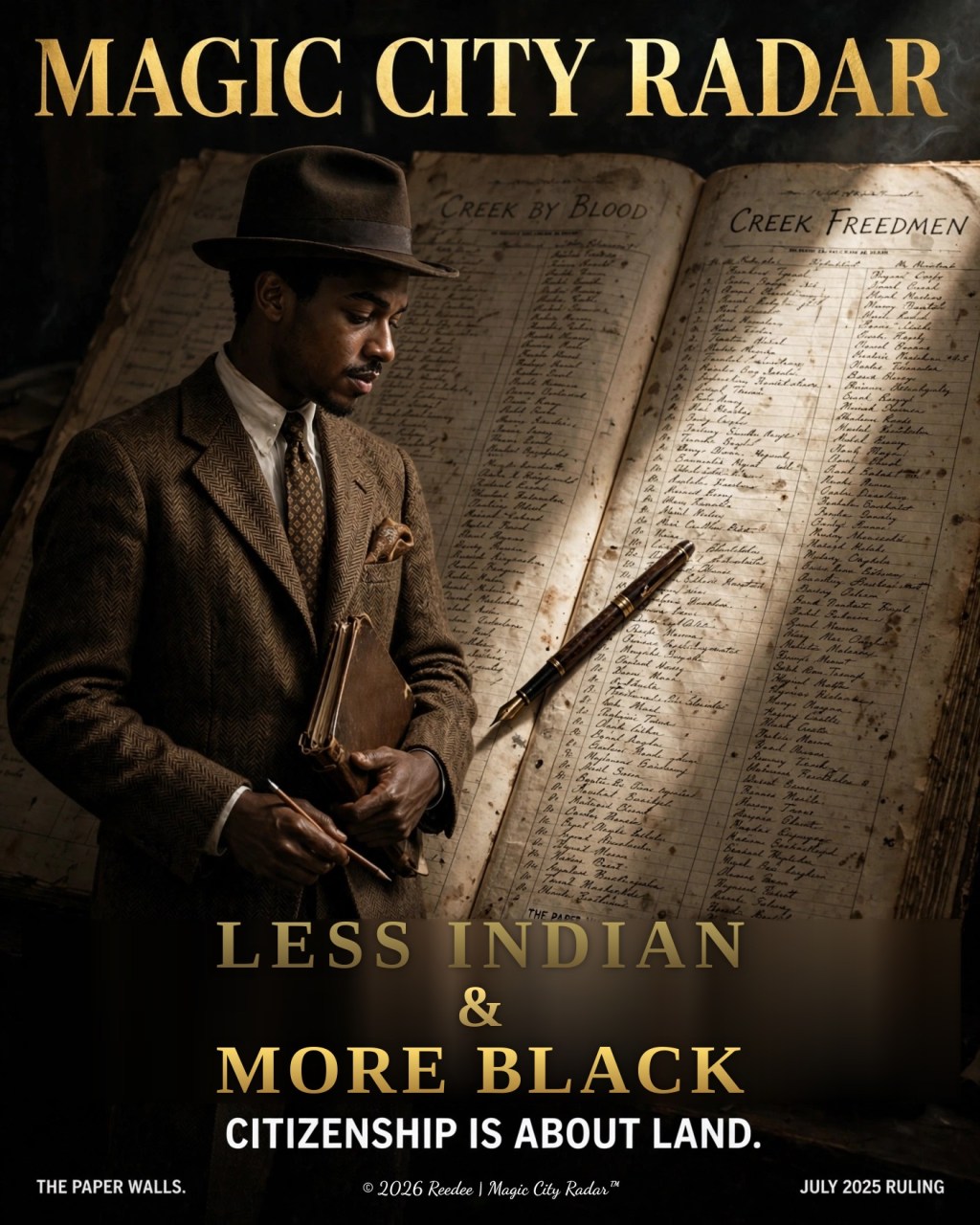
Around 1900, the Dawes Commission set up its tables and began writing names into columns. “Creek by Blood” in one column. “Creek Freedmen” in another. The agents looked at skin before they looked at kinship. A Black man with a Muscogee grandmother went into the Freedmen column because his face told the agent where he belonged. The pen moved. The column filled. And eighty years later, men in suits would point at those columns and say: look — they were never really Indians at all.
In 1979, the Muscogee Nation wrote a constitution. It limited citizenship to those descended from the “by blood” roll. With that one sentence, the Freedmen — citizens by treaty — became outsiders by law. They could not vote. They could not hold office. Their children inherited the locked door the way other children inherit land.
The Cherokee Nation ran its own version of this exclusion until a federal court forced its hand in 2017; the “by blood” language came out of their constitution in 2021. The Muscogee held the line four years longer.
The ruling: July 2025
In July, the Nation’s own Supreme Court read the Treaty of 1866 and found what had been there all along. The “by blood” requirement was unlawful under the treaty. The case went back to the Citizenship Board with its instructions: enroll the descendants of the by-blood roll and the Freedmen roll alike.
Damario Solomon-Simmons, the plaintiffs’ attorney, is himself descended from Cow-Tom. He called the decision “a victory against anti-Black racial discrimination, for the rule of law and for the sanctity of Indian treaties.” He was being polite. What happened was simpler and more brutal: the machine choked on its own document.
The Paper Walls: Citizenship Is About Land
The ruling knocked down a wall. But a man should see the full height of what stood over him. There were three walls, and every one of them was made of paper.
The first wall: the Dawes Rolls. Federal agents with ledgers, sorting human beings into columns. They saw color and called it blood. A Black family with Creek ancestry went into the Freedmen column because that was where Black faces went. A clerk’s pen stroke in 1900 became, eight decades later, the legal ground for saying: you were never one of us. Paper did what guns had done — it drew a line and dared a people to cross it.
The second wall: blood quantum. This was not an Indian custom. No tribe ever measured belonging in fractions. It was Washington’s invention, imposed from above, and it is arithmetic with a purpose: every generation of intermarriage halves the number, until the grandchildren of the same families mathematically cease to be Indian. It is a machine for making Indians disappear without firing a shot, and it is still running.
The third wall: the 1979 constitution. The Nation wrote “by blood” into its own founding law and turned the key. No vote. No office. No services. The Seminole Freedmen fought their way back to the ballot box through the courts in 2002 — and still find the doors to housing and education benefits half-closed. The walls have layers. They always have layers.
Now understand what the walls were guarding. Tribal citizenship is not a certificate to hang on a wall. It is the key to the storehouse: housing assistance, schooling, healthcare, per capita payments, land rights. Every device that kept Freedmen descendants outside the citizenry kept them outside the storehouse. The treaty of 1866 promised citizenship. The paper walls made sure the promise could never be collected. A promise you cannot collect is not a promise. It is an insult with a signature on it.
And here is the contradiction the court could not look away from: the Muscogee Nation defended its reservation in McGirt v. Oklahoma (2020) by holding up the Treaty of 1866 — the same treaty that guaranteed Freedmen citizenship. The Nation used the treaty as a shield for its land and as a sword against its Black citizens. In July 2025, the court took the sword away.
This is why the story does not end in a courtroom, and why Black people in Alabama and everywhere else should be watching it with both eyes open. If Black families could document Native lineage at scale, it would not be a matter of heritage-month pride. It would mean land claims. It would mean tribal benefits. It would mean a seat at every table where the debts owed to Indigenous people are being counted. The design of the system — miswrite them on the rolls, shrink them by fractions, lock them out by constitution — prevents exactly that. It prevents Black people from standing on Native ground and demanding what is owed. Call it intent or call it function. The hunger it produces is the same.
Alabama’s living chapter
This story was born in Alabama, and Alabama is still living it.
In Escambia County, the Poarch Band of Creek Indians — federally recognized in 1984, the only federally recognized tribe in the state — descends from Creeks who refused removal in the 1830s. They stayed on their land and held their community together for nearly two hundred years against poverty and contempt. They did not leave. They endured.
In the southwest of the state, the MOWA Band of Choctaw Indians — recognized by the state — descends from mixed communities of free Black, white, Creole, and Native people. The intermingling did not end at removal. It put down roots and became a people.
And the reckoning runs deeper than citizenship. In April 2024, the University of Alabama returned the remains of 10,245 Indigenous ancestors and 1,520 lots of funerary objects — dug out of Moundville and the surrounding ground over decades — to eleven tribes. It is believed to be the largest return in the history of the repatriation law. The dead are going home. It took the living long enough to let them.
A note of care
An honest account must say what the records say and no more. The blending was never complete. By the 1790s, many Black families among the Creeks held to a cultural identity of their own, separate from their neighbors — the records are clear on that. And as Henry Louis Gates Jr. has warned, verifiable Native ancestry among Black Americans is the exception, not the rule, concentrated in the Five Tribes whose documents prove it.
The Freedmen story stands because it is written down: in treaties, in rolls, in court decisions, in bloodlines the Archives confirm were mixed. Paper built the walls. In the end, paper brought one of them down.
Indigenous Peoples’ Day
Monday is Indigenous Peoples’ Day. Sit with what was actually restored here. Not paperwork — belonging. The Freedmen were never strangers to the Nation. They married into it, spoke its tongue, walked its trail of tears, and governed in its councils. A constitution tried to make them outsiders. The treaty always said otherwise.
One hundred and fifty-nine years. Count the cost of every one of them. Then welcome them home.
Sources: WAMC/AP reporting on the Muscogee Nation citizenship ruling (Sept 2023) and the July 2025 Supreme Court decision (via Wikipedia’s Muscogee Freedmen article, which cites the ruling); National Archives, Records of Rights (“Home of Creek Freedmen, ca 1900”); University of Alabama official repatriation statement (July 29, 2024); Poarch Band of Creek Indians official history (pci-nsn.gov); Encyclopedia of Alabama (Poarch Creek Indians); Kathryn E. Holland Braund, “The Creek Indians, Blacks, and Slavery,” Journal of Southern History (1991).

