
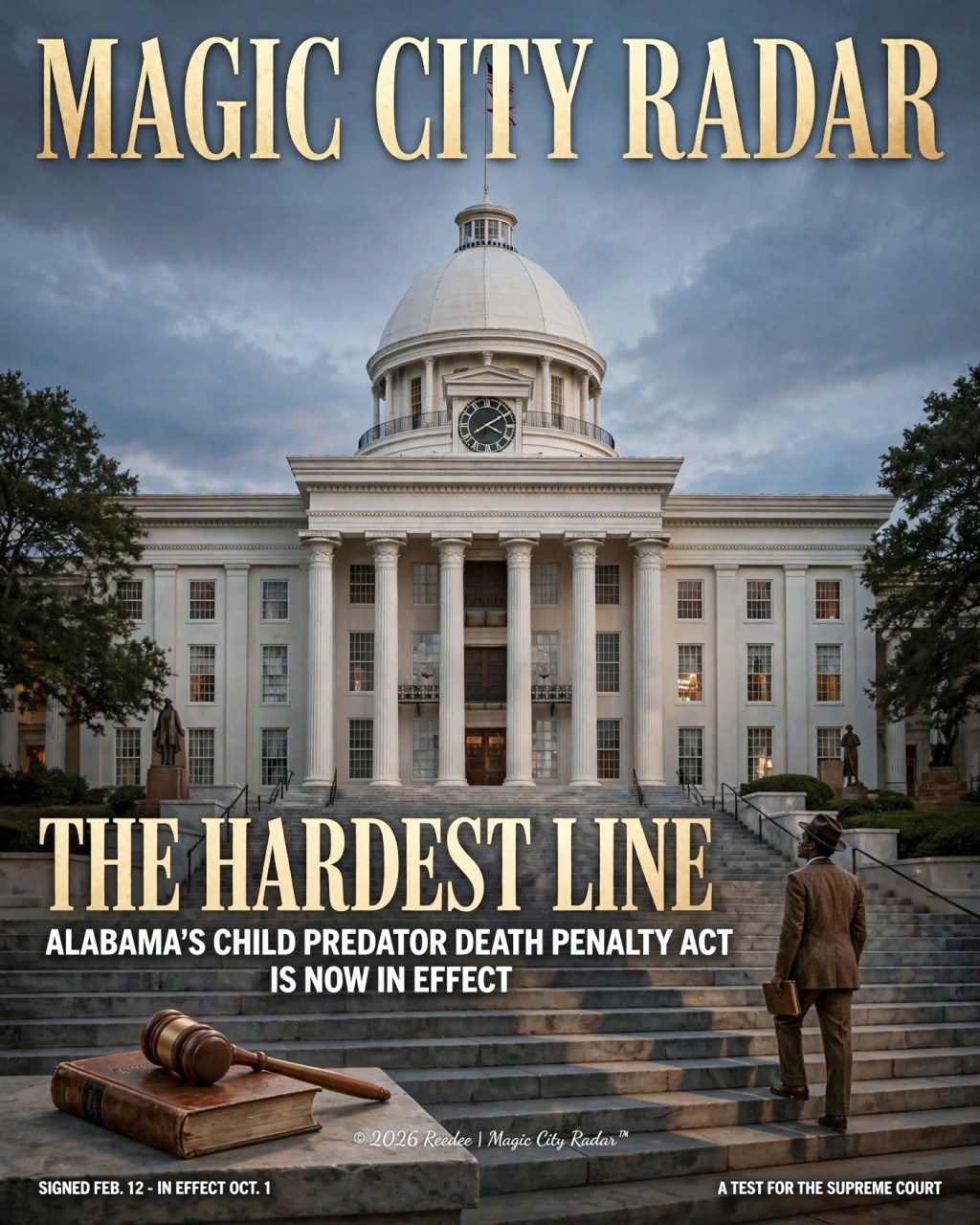
By: Magic City Radar

The record is as follows.
On February 12, 2026, Governor Kay Ivey signed House Bill 41, the Child Predator Death Penalty Act. The House of Representatives passed it by a vote of 73 to 6. The Senate passed it by a vote of 33 to 1. On October 1, 2026, the law took effect.
Under this act, first-degree rape, first-degree sodomy, and first-degree sexual assault committed against a child under the age of twelve are capital offenses in the state of Alabama. The punishment is death, or life in prison without the possibility of parole. Before October 1, these same offenses were Class A felonies. The maximum sentence was life, with the possibility of parole preserved in law. That possibility no longer exists.
These are the facts. What follows is how they came to be, and what they will be used to do.
The case on record
The Legislature did not act on a theory. It acted on a case.
In 2025, officers in Bibb County arrested eight persons. The charge: that at least ten children had been held captive and subjected to rape, trafficking, and sexual torture. The youngest of the children was three years old.
Governor Ivey placed the bill at the center of her State of the State address. At the signing, she stated the administration’s position in its own words: “For too long, the most vulnerable of our society have lacked the most stringent legal protection from child predators.” Attorney General Steve Marshall commended the Legislature for providing prosecutors “the tools they need to pursue the ultimate penalty.” The bill’s sponsors were Rep. Matt Simpson of Daphne and Sen. April Weaver of Brierfield. Local prosecutors, among them Shelby County District Attorney Matt Casey, have since instructed the public on how the act enlarges the state’s capital framework.
The stated purpose of the law is protection. The mechanism is punishment. Both are now a matter of record.
The ruling the law contradicts
In 2008, the Supreme Court of the United States decided Kennedy v. Louisiana. The vote was 5 to 4. The Court held that the Eighth Amendment forbids the execution of a person for the rape of a child where the crime did not result, and was not intended to result, in the child’s death.
That decision has not been overturned. It has not been modified. It stands today as it stood in 2008.
Alabama is the sixth state to enact such a statute since that ruling. Florida preceded it. Tennessee preceded it. Idaho, Oklahoma, and Arkansas preceded it. The Death Penalty Information Center, which records these enactments without advocacy for either side of the question, documents each one. The legal monitors who track capital law are in agreement on one point: a statute of this kind, applied to a living defendant, will be challenged, and the challenge will be carried to the Supreme Court.
The sponsors of this law do not dispute this. They rely upon it. Their argument, stated openly, is that the Court measured the nation’s consensus in 2008 and that the measure should be taken again — with Alabama’s 73-to-6 and 33-to-1 entered into evidence.
The first prosecutor who seeks a death sentence under this act will therefore not be trying one case. He will be opening a national one. The defendant will be a man accused of a crime against a child. The question before the Court will be whether the Constitution permits his execution. Both things will be true at once, and the record will contain both.
The first entries under the new law
The act has been in force since October 1. Within days, an undercover operation in Atmore produced seventeen arrests. Among those arrested were three public officials: a member of the state House of Representatives who had voted for this act, the president of a city school board, and a city public works director.
The record must be kept precisely here. The representative’s charge was subsequently amended by prosecutors to an attempted offense, the operation having been a sting in which no actual victim existed. No defendant named in that operation has been convicted of any offense. Each is presumed innocent under the same Constitution this act will ask the courts to reinterpret. What the arrests establish is narrower, and sufficient: the offenses this law addresses are not abstractions, and they are not strangers to the institutions charged with policing them.
What changes in an Alabama courtroom
The practical consequences are these. A prosecutor in Jefferson County, or in any county of this state, who brings a charge of rape, sodomy, or sexual assault against a child under twelve now brings a capital charge. A capital charge requires capital defense. It requires a longer trial, a larger record, and years of appeals that follow by operation of law.
Advocates for victims raise one question, and it is recorded here because it will be raised in every county courthouse in Alabama: whether a child who must testify against a person known to her — as the accused is known to the victim in the great majority of these cases — will be brought forward by her family at all, when the sentence at the end of the proceeding may be death. Prosecutors answer that the severity of the charge will compel guilty pleas, and that children will be spared the stand. Both predictions are on the record. Neither has yet been tested.
What is not in dispute is the line itself. It was drawn on February 12, it took force on October 1, and it is now the law of Alabama: for the worst crimes committed against the youngest children, the state will seek the ultimate sentence, and it will do so in the certain knowledge that the federal courts will be asked whether it may.
The Radar will keep the record as the cases come.
Sources: Office of the Governor (signing release, Feb. 12, 2026); WAFF 48; WBRC Fox 6; WVTM 13; Alabama Daily News; 1819 News; Death Penalty Information Center; Alabama Attorney General’s Office.

